

Technical reference: a receiving-card interface. It illustrates component-level discussion and is not evidence that a particular board was replaced.
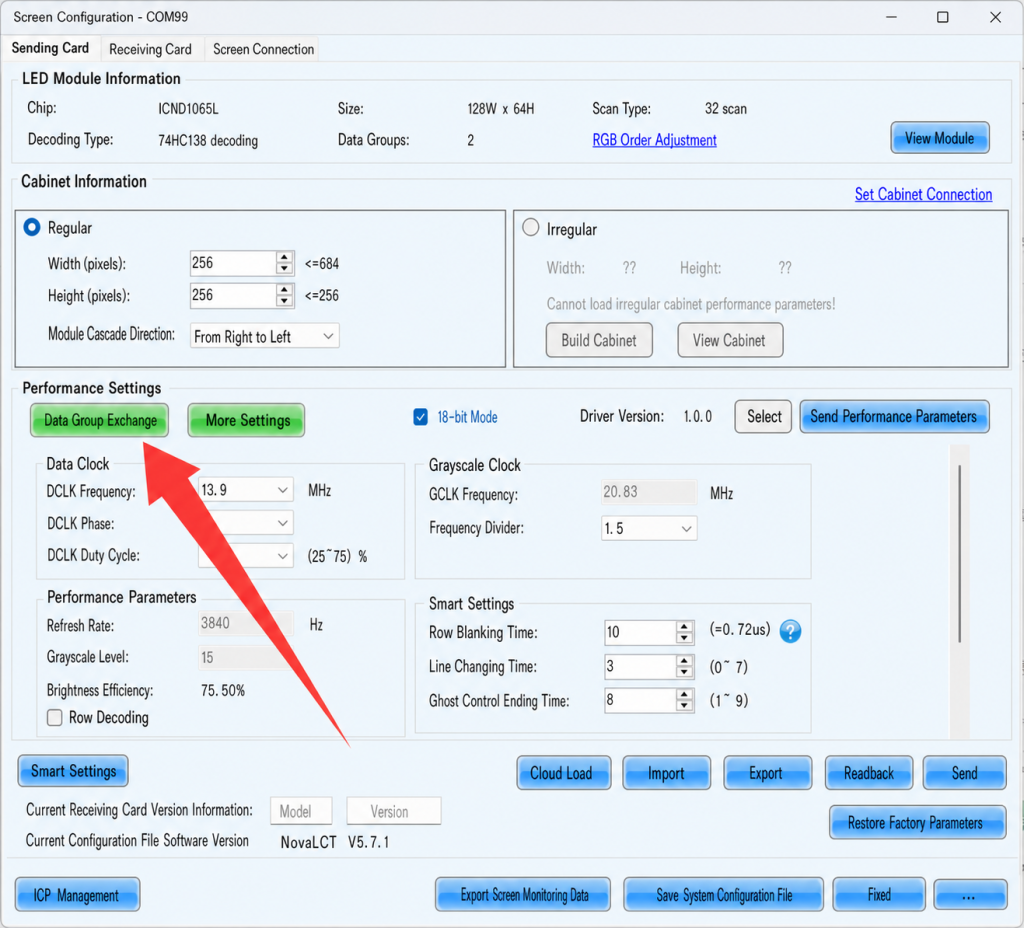
Technical reference: a configuration screen. It supports explanation of re-test conditions and does not prove a batch result by itself.

Field reference: a live display environment. It illustrates the kind of visible result that must still be tied to a cabinet record.
Repair is not the opposite of quality. For used LED equipment, documented repair can be part of a responsible preparation process. The quality risk appears when a repair is performed without a clear original fault, without a record of what changed, or without a repeat test that shows the result. Q04 exists to keep the repair action connected to the evidence chain: documented issue, controlled action, re-test, and status.
The gate begins with the fault list from Power-on Diagnosis. That list should identify the cabinet or physical unit, describe the visible symptom, and provide enough context for a technician to reproduce or investigate the issue. A general note such as “screen problem” may not be sufficient. A useful record can identify the cabinet position, the affected area, the test content, the connection condition, and the next diagnostic question. The exact form depends on the internal method, but the principle is stable: repair should respond to a recorded observation.
Before physical work, power must be isolated fully. Qualified personnel should follow the approved electrical and manufacturer procedures, verify the safe state, and use the correct handling method for modules, power supplies, receiving cards, connectors, and other parts. A quality article should never suggest that a component can be changed while the system remains energised. Safety boundaries protect people and also prevent a repair from creating a second fault.
The technician then investigates the documented issue. The action may involve a module, cable, connector, power component, receiving card, configuration parameter, mechanical part, or another approved intervention. The public wording should not claim a particular part was changed unless the actual record confirms it. It should say that the action, substitution, configuration change, or calibration result is recorded. If the cause is still uncertain, the cabinet should remain in diagnosis rather than being described as repaired.
Substitution records protect traceability. When a component is changed, note the affected cabinet, the part or component category, the action taken, and the result required for re-test. If the internal process records serial numbers, source parts, or technician details, those records can remain in the quality file. The customer-facing explanation does not need to expose every private field, but it should make the logic clear: the repair did not disappear into a general “passed” count.
One-variable testing is useful when the fault is difficult to isolate. If the technician changes a cable, configuration, module, and controller setting at the same time, a later improvement may not reveal which change solved the problem. Under the approved internal procedure, change the relevant variable, observe the result, and preserve the comparison. This makes the re-test more meaningful and reduces the chance that a temporary workaround is mistaken for a confirmed repair.
The re-test should target the original symptom and any related function that the approved method requires. If the original issue was a visible colour or data-group problem, the re-test should use an appropriate pattern or content and the same relevant connection conditions. If the issue involved power behaviour, the technician should repeat the applicable check safely. If a mechanical repair affected cabinet fit, the physical condition should be reviewed again. The exact test is product-specific; the requirement is that the re-test answers whether the documented issue was corrected.
Before-and-after evidence can help. A clear fault photograph, repair note, and re-test photograph create a simple narrative. The before image shows what was observed. The repair record shows what was done. The after image shows the result under the relevant check. These images are not valuable because they look dramatic. They are valuable because they belong to the same cabinet identity and the sequence is understandable.
Repair status must remain visible. A cabinet may be repaired and ready for the next observation, repaired but pending a longer check, awaiting a part, or still unresolved. The team should not move it into the released quantity merely because a component was changed. Release depends on the complete quality path. Keeping the status open protects the customer and prevents the quality record from overstating what has been proven.
This distinction matters for international buyers. A buyer may accept that used equipment has a repair history if the history is explained and the result is checked. What creates distrust is a missing connection between the original problem and the final claim. A short, honest repair note can be more useful than a broad statement that no issues were ever found. It lets the customer understand the preparation process and ask a technical question before dispatch.
Q04 also protects future service. If a cabinet returns for after-sales coordination, a repair and re-test record can help the technician understand what was previously observed. The record should remain associated with the batch and cabinet identity according to the company’s retention practice. A reused component or configuration change may be relevant to a later diagnosis. The purpose is not to predict every future fault; it is to avoid losing the known history.
The output of Q04 is a repair record and a re-test result linked to the original fault list. That output should be clear enough for the next gate to decide whether the cabinet can join continuous aging, needs another diagnostic action, or remains pending. It should also be clear enough for the customer-facing team to say what happened without inventing a guarantee.
Repair earns confidence only when the result can be checked. By isolating power, documenting the fault, preserving the action and substitution record, testing one relevant variable at a time, and repeating the applicable function check, Stellux gives a corrected cabinet a traceable path back into the batch.
